

The more your audience grows on Instagram, the harder it is to keep content consistent, respond quickly, and move conversations toward conversion. If you’re here, you’ve realized manual posting and one-by-one replies won’t scale and it’s time for software that automates the busywork while keeping your brand human. Good call.
Our best-apps lists are written by humans who spend much of their time using, testing, and writing about software. Unless otherwise noted, we spend hours hands-on with each pick, using the tools as intended and scoring them against criteria for this category. We’re never paid for placement in our articles or for links, we rely on reader trust, so our evaluations stay independent.
For Instagram-first automation, the right platform should excel at:
| App | Best for | Standout feature | Pricing |
|---|---|---|---|
| BotSpace | DM/comment automation + commerce | Shared inbox with IG automations, product/catalog flows, and pay links | Free; Pro: $15/month; Premium: Custom |
| ManyChat | Creator & SMB growth funnels | Comment-to-DM + keyword triggers builder | Free; Pro: $15/month; Elite: Custom |
| SendPulse | Instagram lead gen + multichannel follow-up | Bio link page with chatbot triggers, comment/DM automation, and connected email/SMS flows | Free; Pro: from $10/month |
| Getgabs | Instagram DM automation + lead qualification | Comment-to-DM, story replies, AI chatbot, and a shared team inbox | See Getgabs pricing page |
| Sprout Social | Team workflows & reporting | Smart Inbox + automation rules/approvals | Standard: $199/month; Professional: $299/month; Advanced: $399 /month; Enterprise: Custom |
| Later | Visual planning & conversions | Link-in-bio (multi-link) with analytics | Starter: $18.75/month; Growth: $37.50/month; Scale: $82.50/month |
| Buffer | Simple, reliable scheduling | Queues, best-time suggestions, first comment | Free; Essentials: $5/month; Team: $10/month |
BotSpace (Web, iOS, Android)

Pros
Cons
Why it made the list
BotSpace treats Instagram as a revenue channel, not just a posting surface. Run growth plays like comment-to-DM and story-reply keywords to capture intent, then route to an AI-assisted inbox for quick, on-brand replies. From there, you can push product cards, payment prompts, or post-purchase updates right inside the conversation. If you already rely on CTWA or IG lead ads, BotSpace closes the loop by turning touchpoints into measurable chats and, ideally, checkouts.
ManyChat (Web)

Pros
Cons
Why it made the list
ManyChat popularized IG DM funnels for creators and small teams. You can launch a “comment a keyword to get the PDF” or “DM ‘DISCOUNT’ to unlock the code” flow in minutes, capture the lead, and set automated follow-ups. If your priority is turning engagement into opt-ins and micro-conversions without a steep learning curve, this is an easy on-ramp.
SendPulse (Web, iOS, Android)

Pros
Cons
Why it made the list
Most Instagram automation tools stop at the DM. SendPulse is built for what happens next. You can drop a bio link in your Instagram profile that opens a branded page — complete with subscription forms, chatbot opt-ins, countdown timers for offers, and payment buttons. From there, any lead who subscribes gets pulled into automated flows spanning Instagram DMs, WhatsApp, email, and SMS, all managed from a single platform.
For creators or small brands who are running Instagram as a top-of-funnel but need a structured way to capture, nurture, and convert those leads across channels without stitching together multiple tools, SendPulse closes that loop in one place.
Getgabs (Web)
Pros
Cons
Why it made the list
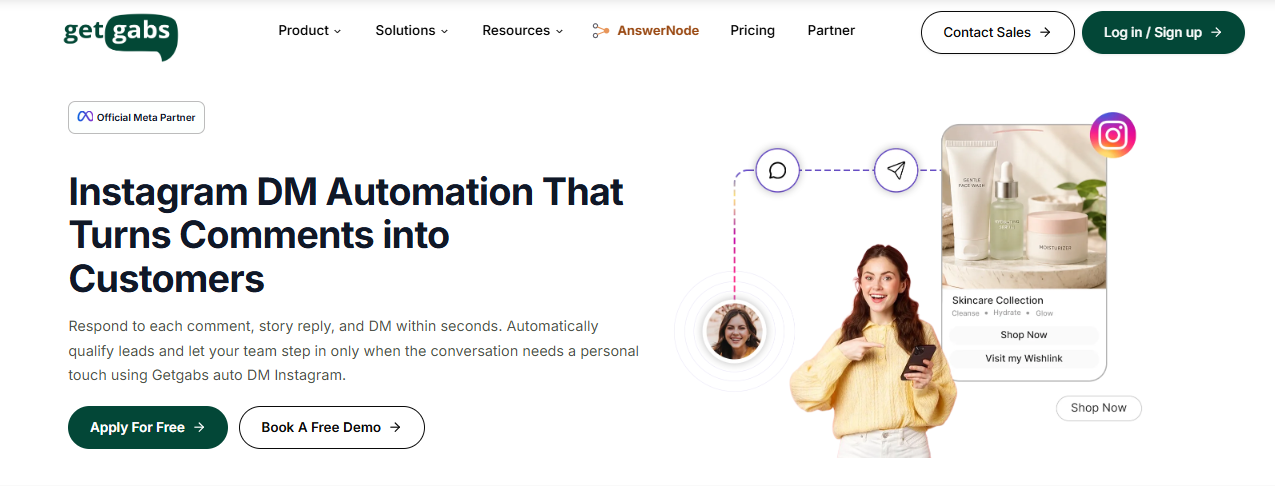
Getgabs handles the standard Instagram comment-to-DM play: someone comments a keyword like “Price” or “Guide” on a post or Reel, and the tool replies publicly and sends the details by DM. Its AI chatbot can answer FAQs, qualify leads, and hand harder questions to a person, and the shared inbox lets teams tag and assign chats. It suits brands that want to cut down repetitive Instagram replies while keeping a human in the loop. It also covers WhatsApp, so the same platform can handle both channels.
Customers.ai (formerly MobileMonkey) (Web)

Pros
Cons
Why it made the list
Customers.ai is built for marketers who want precise control over triggers, tags, and routing. It shines when your flows rely on specific keywords or when you need to segment fast, send a resource, route high-intent users to sales, and park the rest in a nurture sequence.
Sprout Social (Web, iOS, Android)

Pros
Cons
Why it made the list
Sprout is the safe pick when multiple people manage one brand. You get publishing calendars, approvals, and a Smart Inbox that can auto-tag, assign, or hide based on rules so the right person sees the right message. If governance and reporting matter as much as automation, Sprout’s balance is hard to beat.
Later (Web, iOS, Android)

Pros
Cons
Why it made the list
Later is a planner first, automation second. If your bottleneck is “keeping the feed consistent and clickable,” Later helps you stage content visually, publish at the right time, and channel traffic through a customizable link-in-bio that actually converts.
Buffer (Web, iOS, Android)

Pros
Cons
Why it made the list
Buffer is the minimal-friction way to automate posting and keep pace with comments/DMs. If you don’t need enterprise governance, its queues and engage tools cover the essentials freeing you to spend more time on creative and less on logistics.
The best tool is the one you can actually roll out and use daily to keep followers engaged and customers converting. Any of these picks can help, but if your goals include DM/comment automation, in-thread commerce, and a shared inbox with AI assist, BotSpace is purpose-built for that loop. Start with comment-to-DM and story keywords, layer in AI replies, then plug in catalogs and pay links to turn conversations into revenue, all without leaving Instagram.
The new age of AI-first customer engagement starts here
